Pimax Crystal Pro: 60 GHz VR without video compression, Linux plans and shipping in 2027
By Gameforest Redaktion Published 3 min read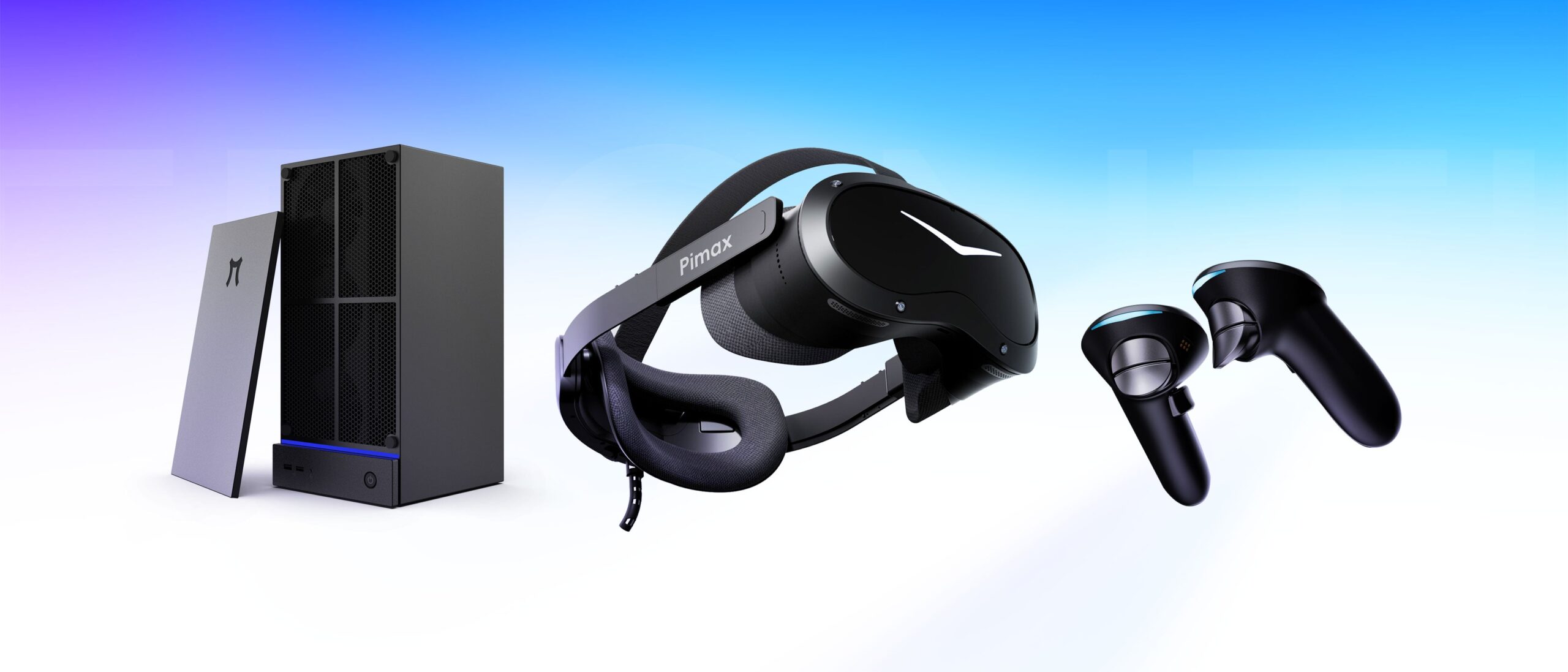
Pimax aims to break the cable constraint of high-end PC VR headsets without relying exclusively on compressed Wi-Fi streaming. The Crystal Pro, unveiled on 6 October, combines a conventional Wi-Fi route with an optional 60 GHz radio system. At the same time, the manufacturer is planning its own VR computer with SteamOS support and announces its configuration software Pimax Play for Linux. A concrete sales launch for the headset is still outstanding; the current product page gives 2027 as the start of shipping.
What to expect here
Two radio routes – with different requirements
According to the manufacturer, the Crystal Pro’s scope of delivery includes a Wi-Fi adapter, an external 16,000 mAh battery and two classic VR controllers with tracking rings. The optional 60G AirLink requires additional antennas on the headset as well as two room antennas. The two transmission routes are not to be equated: over Wi-Fi, the image is transmitted as a video stream, as with common PC VR solutions. At 60 GHz, by contrast, the image area on which the eyes are currently focused is to be transmitted without the usual video encoding.
Pimax gives a combined bandwidth of up to 6 Gbit/s and less than two milliseconds of additional transmission latency for the radio connection. These are manufacturer figures, not independently measured performance values. The system also requires a suitable connection within the same room: 60 GHz signals do not penetrate walls. The higher data rate alone therefore does not guarantee a better VR connection in every home situation.
The headset uses two QLED panels, each with 2,880 × 2,880 pixels, mini-LED backlighting and up to 120 Hz. The integrated eye tracking serves not only dynamic image calculation but also targeted radio transmission. Those who prefer a classic cable connection should be able to use DisplayPort 1.4a. Exchangeable front modules are provided for various tracking and mixed reality configurations.
Linux is to join in, from accessories to the PC
The announcement goes beyond a single headset. Pimax is introducing new Ringless VR Controllers, which work as motion controllers and can be clipped together to form a conventional gamepad for games outside the VR environment. They are a standalone new release: with the Crystal Pro itself, the conventional controllers with tracking rings are initially included in the package.
Added to this is Spation, a compact computer for PC VR with desktop components. The manufacturer names configurations with a Ryzen 7 9800X3D or comparable CPU, a Radeon RX 9070 XT or GeForce RTX 5070 Ti, and 32 GB RAM. Windows and SteamOS are to be supported. In addition, Pimax has announced a Linux version of Pimax Play. When the software will be finished and how comprehensive the Linux driver support will be cannot yet be deduced from this.
High entry price, shipping not until 2027
For the Crystal Pro, Pimax names 1,399 US dollars as the manufacturer’s price and 1,899 US dollars for the bundle with 60G AirLink. The radio system is to cost 599 US dollars separately. These are not confirmed German end prices; taxes and regional terms may differ.
The current manufacturer product page allows a reservation for one US dollar, but labels this payment as non-refundable. Demonstrations are planned for the fourth quarter of 2026, with shipping in 2027. Dates and prices for the Ringless controllers and the Spation computer remain open. So far, what exists is mainly a technical plan: whether the new radio method can match the image quality and stability of a cable connection in everyday use still needs to be shown by independent practical testing.
Official sources: Pimax: product announcement of 6 October 2026, Pimax: Crystal Pro product page with reservation and shipping details.

