Switch 2: Nintendo hält an Spielkarten fest – aber was steckt in der Hülle?
By Gameforest Redaktion Published 4 min read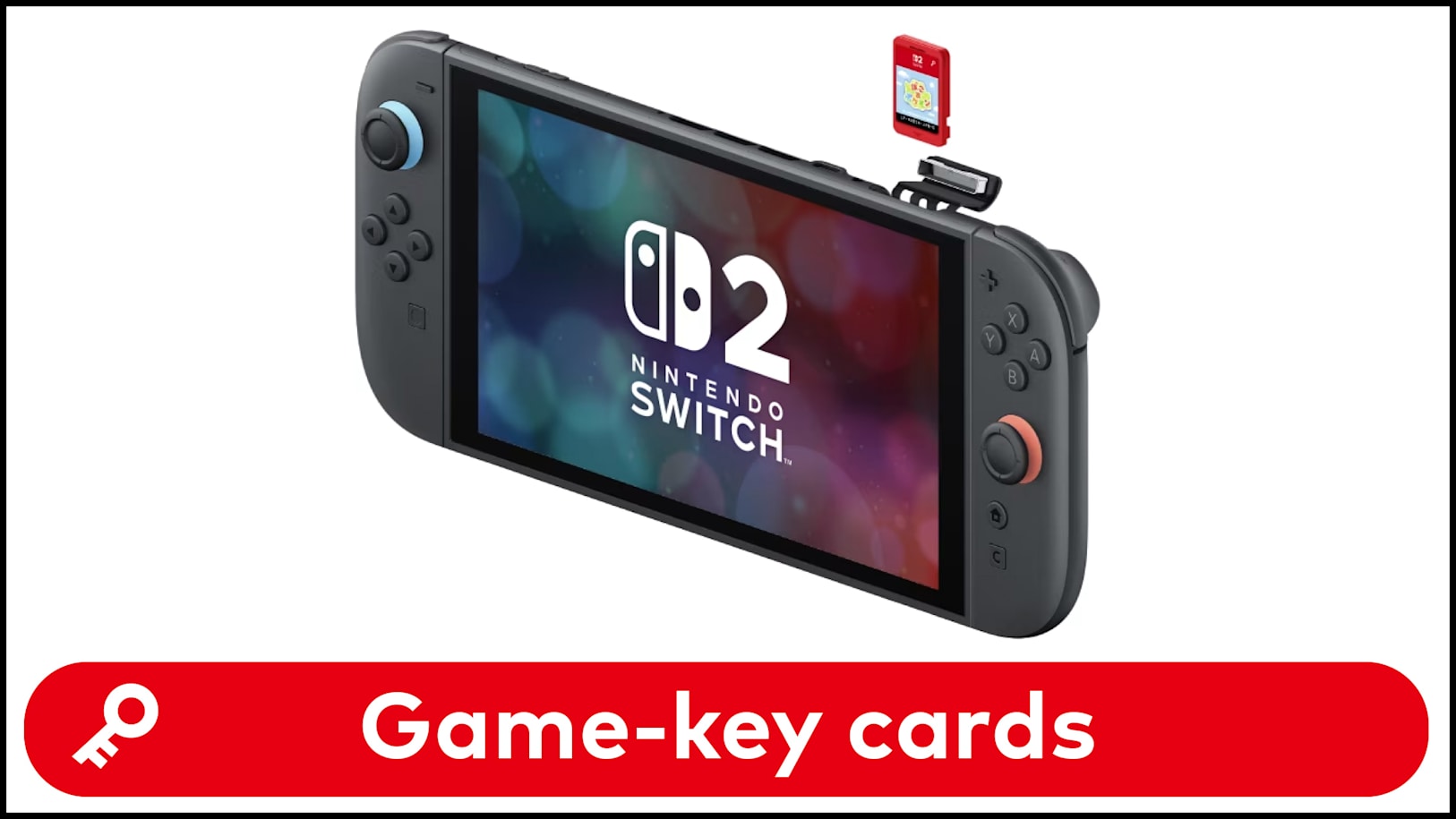
A game case on the shelf does not automatically mean that the complete game is on the enclosed card for the Nintendo Switch 2. This distinction becomes important following a recent statement from Nintendo’s senior management: physical releases remain part of the strategy as things currently stand. Bill van Zyll, Nintendo’s Vice President and General Manager for Latin America, said at the Brasil Game Show 2026 in an interview with Coelho no Japão that there are currently no plans to discontinue physical games. This is a statement about the distribution format – not a commitment that every box will in future contain a module that can be played without a download.
What to expect here
Two different cards under the same roof
On its German information page, Nintendo distinguishes between standard software cards and software key cards, known internationally as Game-Key Cards. Classic software cards contain the game data. With a software key card, by contrast, only the key for downloading the game is initially included in the packaging. The software can only be launched once it has been downloaded to the internal storage or to a microSD Express card.
At first glance, both belong to the physical range: both come as a card in a case and are inserted into the console. The consequences, however, differ. Anyone who inserts a standard card receives the stored game data directly from the cartridge; a Game-Key Card must first obtain the actual program online. The console’s available storage capacity therefore also plays a role with the second format.
Why ‘physical’ does not mean the same as ‘entirely on the card’
According to Nintendo’s own explanation, the Game-Key Card is not an ordinary download code that is redeemed once and then put aside. The card must remain inserted while playing. After the first download, no internet connection is generally required to start the game again on the same console. If the card is used in another Switch 2, the data must first be downloaded there as well.
The format can also be passed on. In its own comparison of distribution models dated 23 September 2026, Nintendo explains that Game-Key Cards are not tied to a Nintendo Account and can be lent to other people. They therefore retain a key advantage of classic cartridges, but require a working download option for the first use. It follows that a box alone does not guarantee a full installation that remains available in the long term, independently of Nintendo’s servers.
The statement comes from Latin America
Van Zyll did not speak at a worldwide product presentation, but in conversation with a Brazilian YouTube channel during the Brasil Game Show. He emphasised the focus on customer wishes and pointed out that physical games are particularly in demand in Brazil and across the wider Latin American region. This explains why Nintendo is not aiming for a fundamental departure from the format there. However, it is neither a timetable for future cartridge production volumes nor a promise that all regional markets and all publishers will supply every game on a fully populated card.
It is also important to distinguish between Nintendo’s platform support and the decision of an individual publisher. The Switch 2 continues to support both physical card types as well as digital games. Whether a specific new release is offered as a standard card, a Game-Key Card or exclusively digitally cannot be inferred from the general statement made by Nintendo’s manager.
What buyers should look out for with the next game
Anyone who wants to collect or lend a game, or to start it after years preferably without a fresh download, should explicitly check the type of software card before buying. Nintendo marks Game-Key Card packaging with a key symbol. The case also states how much storage space the game requires. The key card marking does not apply to regular software cards. Regardless of this, games can still download updates and require additional content.
The new signal from Nintendo’s management is therefore neither a farewell to physical games nor a return to exclusively fully populated cartridges. For users, the decisive difference now lies within the physical range – and not only between the box and the eShop.
Sources: Coelho no Japão: original interview with Bill van Zyll at the Brasil Game Show 2026; Nintendo Germany: Software key cards; Nintendo: Comparison of software cards, digital games and Game-Key Cards (23 September 2026).