Hogwarts Legacy gets DLSS 5 on 5 November – which PCs the update is meant for
Hogwarts Legacy PC from £3.68 By Gameforest Redaktion Published Updated 4 min read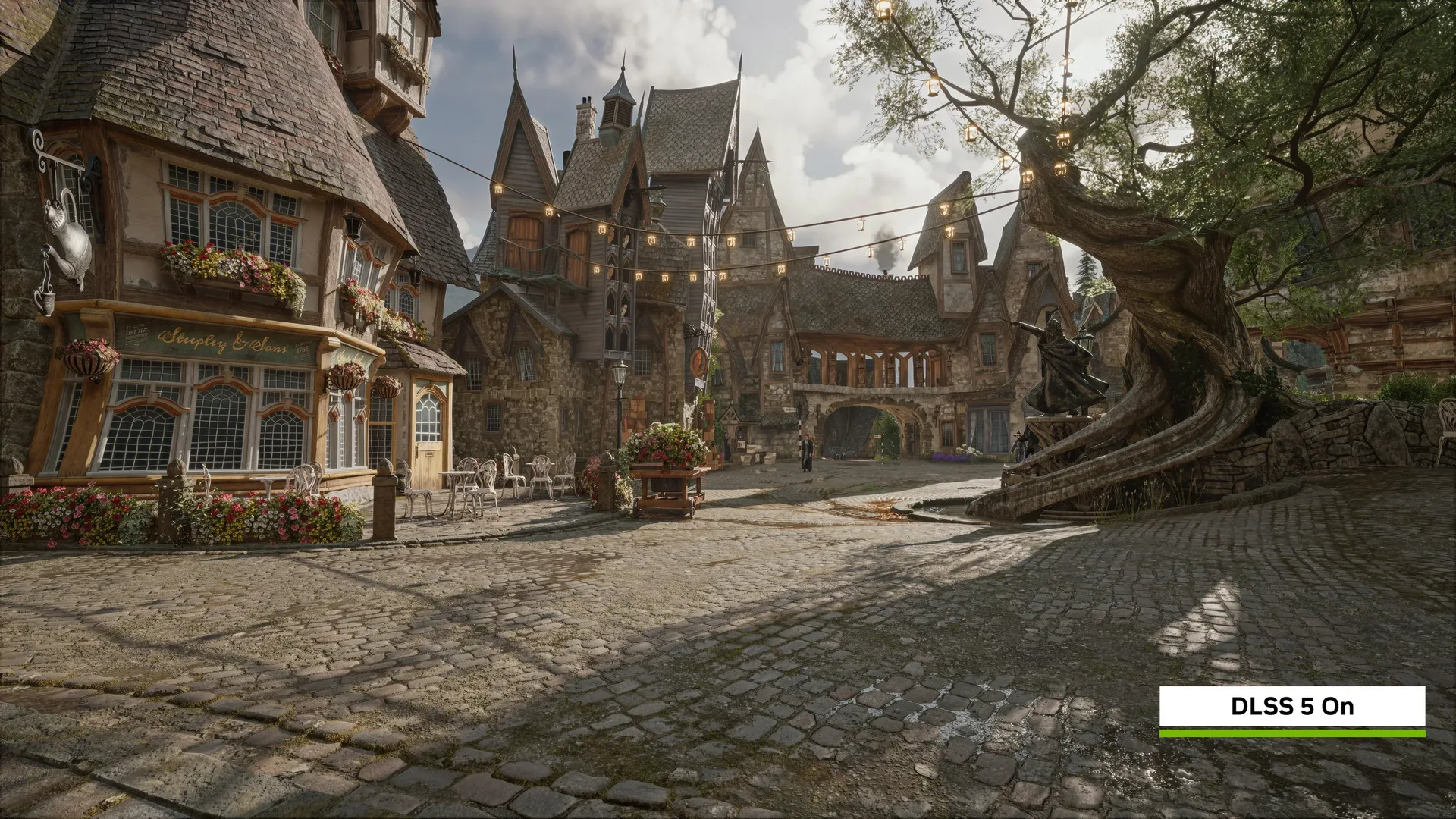
On 5 November 2026, Hogwarts Legacy is due to receive NVIDIA DLSS 5 on PC. The new technology intervenes in the visuals more strongly than the familiar upscaling of images. NVIDIA is announcing an update for this with what it calls 3D-Guided Neural Rendering. It is meant to calculate lighting and surfaces differently. For players, the hardware threshold matters most: not every GeForce RTX card is among the devices named.
What to expect here
NVIDIA’s announcement of 13 October names the GeForce RTX 50 Series, GeForce NOW and RTX Spark for Hogwarts Legacy. The manufacturer does not name any approval for RTX 40 or older graphics cards. The game, of course, remains playable without this new rendering path. The announcement is not linked to a new edition or to paid additional content.
What DLSS 5 changes compared with the existing graphics options
Super Resolution focuses on reconstructing a higher-resolution image. Frame Generation creates additional intermediate frames. The new neural rendering stage, by contrast, is meant to shape light and material properties within the completed rendered image. According to NVIDIA, the geometry already defined by the engine, along with texture and lighting data, serves as the basis. Characters, buildings and levels are therefore not being designed from scratch as a new game world by an AI.
The decision about the look does not rest solely with the graphics card manufacturer. NVIDIA explains that developers receive options for intervening in the process. Avalanche Software has used these tools to tune the DLSS 5 integration for Hogwarts Legacy in order to preserve the intended visual design. This is a statement from the companies involved. How consistent the effect looks in the running game will have to be shown by independent tests after release.
Why the RTX 40 beta is not the same update
On the same day, NVIDIA also presented a faster mode for Frame Generation as a beta in the NVIDIA app. This option is likewise aimed at RTX 40 Series cards. However, it is not the same as the DLSS 5 neural rendering feature announced for Hogwarts Legacy. Anyone already using Frame Generation or Ray Reconstruction in the game does not automatically gain access to the new rendering path.
NVIDIA puts the optimisation of the new neural rendering model at half the computing load compared with the September version, 24 per cent less model size and 20 per cent lower memory requirements at 4K. These are manufacturer’s figures for the model, not measured frame rates from Hogwarts Legacy. The manufacturer also promises to update the game’s existing DLSS features to new versions on 5 November.
Comparison images are not yet a performance test
The two Hogsmeade images published by NVIDIA show the same street with DLSS 5 switched on and off. They make the announced changes to light and surfaces easy to see, but say little yet about image stability during movement, input lag or the actual performance requirements. Neither the scope of possible display controls in the game menu nor concrete frame rates for different RTX 50 models has been confirmed.
For the console versions, including PlayStation 5 and Nintendo Switch 2, the PC announcement contains no new DLSS 5 commitment. Anyone wishing to compare the various native versions, game mechanics and official PC requirements will find the long-standing details in the Hogwarts Legacy game profile.
Enabling DLSS 5: RTX 50 or GeForce NOW Ultimate
The PC update for Hogwarts Legacy arrives on 5 November 2026. On 3 November, NVIDIA described in more detail how to use it: on supported systems, after installation, the Neural Rendering option is to be switched on in the graphics settings. The new Game Ready driver is announced for 4 November. The update and the driver are therefore two separate requirements.
The DLSS 5 feature is intended for GeForce RTX 50 graphics cards, including corresponding notebooks, as well as RTX Spark PCs. For cloud gaming, NVIDIA explicitly names GeForce NOW Ultimate. The DLSS features available so far should be kept distinct from this: Frame Generation on an RTX 40 does not make that card a DLSS 5-compatible GPU.
With the new rendering method, developers are to be able to alter individual image areas to different degrees. NVIDIA names, among other things, settings for texture, hue and masks, with which Avalanche Software can treat characters and backgrounds separately. The promised visual improvements and performance figures still come from the manufacturer. Independent measurements directly after launch remain decisive. The basis is the supplementary NVIDIA announcement of 3 November 2026.
Official technical explanation
In this video published by NVIDIA, the manufacturer explains how neural rendering works together with data from the game engine and the developers’ design specifications.